
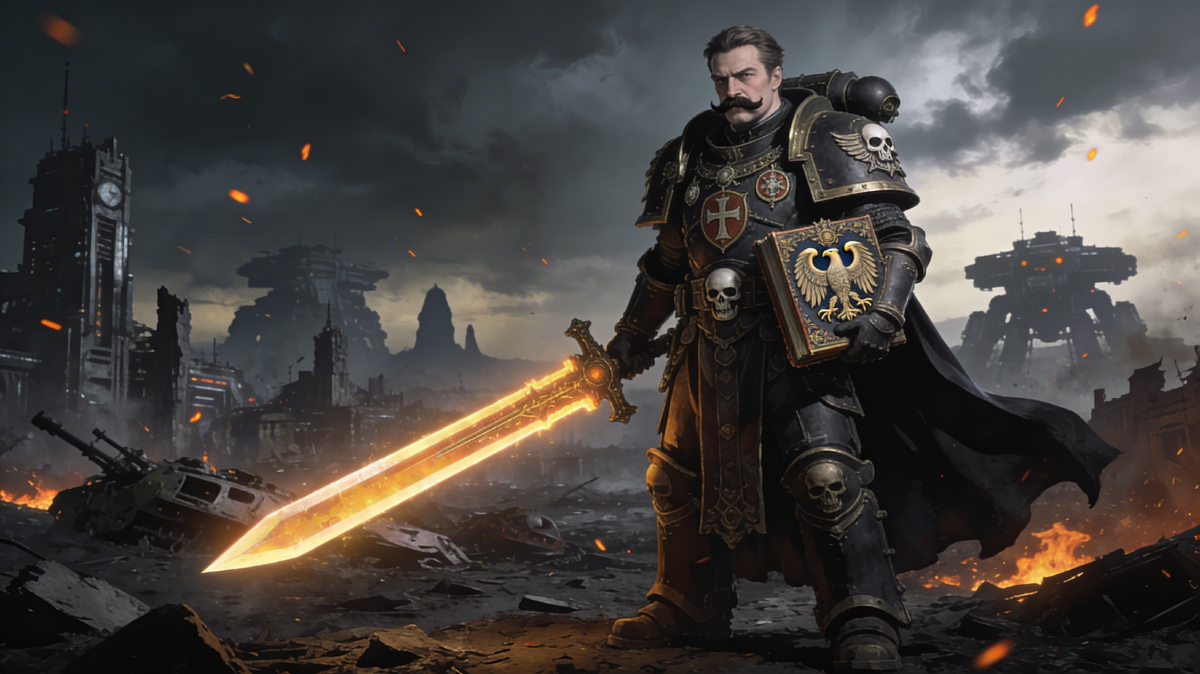

The Galaxy That Was - Understanding the Foundation of Warhammer 40,000’s Cosmic Nightmare#
In the grim darkness of the far future, there is only war. This is not merely a tagline but the fundamental truth of a universe where hope itself has become heresy, where the very act of questioning represents potential damnation, and where humanity’s greatest protector has become its most terrible prison. To understand the tragedy of the Emperor of Mankind—history’s most powerful atheist who became its most worshipped deity—we must first comprehend the cosmic horror that birthed his impossible existence.
The Warhammer 40,000 universe unfolds in the 41st millennium, a time when humanity has spread across a million worlds but finds itself surrounded by extinction-level threats. The Imperium of Man—an empire spanning the entire galaxy—represents both humanity’s greatest achievement and its most terrible mistake, a civilization built on the bones of countless worlds and maintained through systematic brutality, technological stagnation, and religious fanaticism so extreme that it makes medieval Catholicism appear tolerant by comparison.
The Immaterium - Sea of Souls - Empyrean - Realm of Chaos#
At the heart of this setting lies the Warp—known by countless names: the Immaterium, the Sea of Souls, the Empyrean, the Realm of Chaos. This parallel dimension represents the collective unconscious of every sentient being in the galaxy, a psychic ocean where thoughts, emotions, dreams, and nightmares take physical form. The Warp defies all conventional understanding of physics, time, and space; within its tides, yesterday’s fears become tomorrow’s demons, and the accumulated rage of a billion murdered souls can coalesce into a being of terrible power.
Warp as Highway and Hell#
The Warp serves as both highway and hell. Imperial starships navigate its treacherous currents to cross the galaxy, guided by psychic mutants called Navigators who perceive its ever-shifting landscape. Yet every journey risks encounters with the Neverborn—entities formed from the darkest aspects of mortal consciousness. These creatures, called daemons by the superstitious, represent the fundamental truth that in this universe, belief has power, and humanity’s collective nightmares have achieved terrible sentience.
Chaos Gods#
Within this psychic dimension dwell the Chaos Gods—beings of such vast power that they transcend comprehension while remaining utterly dependent upon mortal emotions. Khorne, the Blood God, feeds on every act of violence, growing stronger with each murder committed across the galaxy. Nurgle, the Plague Lord, embodies despair and entropy, his bloated form representing the inevitable decay that awaits all things. Tzeentch, the Architect of Fate, personifies ambition, change, and betrayal, weaving infinite schemes from the threads of mortal ambition. Slaanesh, the Dark Prince born from the hedonistic fall of the Eldar, represents excess in all forms—pleasure, pain, perfection, and depravity.
Great Game#
These entities exist in a state of eternal conflict known as the Great Game, yet their true horror lies not in their power but in their origin. They were not ancient evils waiting to be discovered but beings created by mortals themselves—every war fought in the material universe strengthens Khorne, every plague that spreads feeds Nurgle, every betrayal empowers Tzeentch, every act of excess nourishes Slaanesh. The Chaos Gods represent the ultimate cosmic joke: humanity’s attempt to understand and control the universe has created the very forces that seek to destroy it.
The Imperium’s symbols reflect its contradictory nature. The Imperial Aquila—a double-headed eagle grasping lightning bolts—represents the union of Terra and Mars, the administrative and technological halves of human dominion. Yet this symbol of unity has become a mark of terror across the galaxy, carried by armies that arrive not to liberate but to conquer, to impose a specific vision of humanity that tolerates no deviation. The skull—the most common decorative element in Imperial architecture—reminds citizens that they serve even in death, their bones recycled into service for the God-Emperor who is neither god nor emperor but something far more terrible.
Adeptus Astartes - Space Marines#
The Adeptus Astartes—Space Marines—represent humanity’s attempt to transcend its limitations through genetic manipulation and indoctrination. These warrior-monks, created from the Emperor’s own genetic material, stand eight feet tall, possess two hearts and three lungs, and can survive wounds that would kill a normal human ten times over. Yet their creation required the sacrifice of thousands of children, their transformation involving such extensive modification that they become something no longer entirely human. They fight not for glory or reward but because they know nothing else—their humanity stripped away to create perfect killing machines.
The Imperial Guard—millions of soldiers armed with flashlights (lasguns) against demons and aliens—embodies the Imperium’s fundamental philosophy: human life holds no intrinsic value. Entire regiments die to delay an enemy advance by minutes, their sacrifice recorded only as casualty statistics in reports that few will ever read. These soldiers come from worlds where medieval technology coexists with plasma weapons, where planetary governors rule as absolute monarchs while claiming loyalty to a distant Emperor who cannot speak.
Adeptus Mechanicus - Mars-based cult of technology#
The Adeptus Mechanicus—Mars-based cult of technology—preserves humanity’s scientific knowledge while transforming it into religion. These Tech-Priests believe all technology contains machine-spirits that must be appeased through ritual, their maintenance prayers indistinguishable from actual technical procedures. They worship the Omnissiah—a machine-god they identify with the Emperor—while pursuing technological advancement through methods that resemble medieval alchemy more than scientific research. Their forge worlds produce everything from simple lasguns to continent-sized starships, yet they understand so little of their own technology that they venerate it as divine mystery.
Inquisition - secret police given unlimited authority#
The Inquisition—secret police given unlimited authority—represents the Imperium’s response to knowledge itself as heresy. These agents investigate everything from alien influence to daemon worship, their methods ranging from careful investigation to planetary extermination. They operate through fear and intimidation, their authority deriving from the belief that any deviation from Imperial doctrine represents potential corruption by Chaos. An Inquisitor can condemn an entire world to death based on suspicion alone, their judgment final and irreversible.
The Warp’s influence extends far beyond simple travel and communication. Psykers—individuals with psychic abilities—serve as living conduits between realspace and the Immaterium. Their powers range from telepathy to reality manipulation, yet each use risks daemonic possession or worse. The Imperium’s response to these individuals reflects its fundamental contradictions: it simultaneously persecutes and relies upon them. Untrained psykers face execution as heretics, while those who survive the Black Ships’ journey to Terra become sanctioned psykers, Astropaths, or food for the Emperor’s psychic hunger.
Tyranids - Extra-Galactic Organisms#
The Tyranids represent an external threat of such magnitude that they make all other enemies appear manageable. These extra-galactic organisms travel in hive fleets containing billions of creatures, their arrival marked by the consumption of entire worlds. They represent evolution weaponized, adapting to any defense, learning from every defeat. Their presence in the galaxy forces even the Imperium and Chaos into temporary alliances, yet their true horror lies in their efficiency—they convert biomass into weapons with such speed that a world’s population becomes the next wave of attackers.
Necrons - Ancient Mechanical Beings#
The Necrons—ancient mechanical beings—embody the ultimate rejection of humanity’s understanding of life and death. These skeletal warriors fought a war against reality itself sixty million years ago, their consciousness transferred into metal bodies to achieve immortality. They awaken from tomb worlds across the galaxy, their technology so advanced that it appears magical, their motives incomprehensible to organic minds. Their presence suggests that humanity’s struggle against Chaos represents merely one chapter in a much older conflict.
The Eldar—ancient race in decline—serve as both warning and threat. These psychic beings once ruled the galaxy through mastery of the Warp, their civilization so advanced that they eliminated all need for physical labor or hardship. Their fall created Slaanesh, the Chaos God whose birth consumed their empire and now devours their souls. The survivors split into factions: Craftworld Eldar who fled aboard continent-sized ships, Dark Eldar who embraced depravity to stave off soul-consumption, and Harlequins who serve the Laughing God as eternal performers in cosmic theater.
Tau Empire - Young, Technologically Advanced Civilization#
The Tau Empire—young, technologically advanced civilization—represents what humanity might have become without the Emperor’s intervention. These blue-skinned aliens pursue a philosophy of the Greater Good, their society organized around castes working in harmony. They offer technological advancement and peaceful integration to conquered worlds, their methods appearing almost utopian compared to Imperial brutality. Yet their naivety regarding Chaos and the Warp makes them vulnerable to corruption, their faith in reason and science unable to comprehend that the universe operates by nightmare logic.
Golden Throne#
Understanding the Golden Throne proves essential to comprehending the Emperor’s tragedy. This ancient device—predating the Imperium itself—sustains the Emperor’s physical form while amplifying his psychic presence across the galaxy. Originally intended to create a human-controlled Webway (network of safe Warp tunnels), it became his prison following the Horus Heresy. The Throne requires daily sacrifice of a thousand psykers to maintain its functions, their souls consumed to power the Astronomican—the psychic beacon that guides Imperial ships through the Warp. This device embodies the Imperium’s fundamental equation: humanity’s survival requires continuous human sacrifice on an industrial scale.
Emperor’s Original Philosophy#
The Imperial Truth—the Emperor’s original philosophy—represented perhaps the most radical atheistic doctrine ever conceived. It denied the existence of gods, demons, and supernatural phenomena, explaining everything through rational scientific principles. Daemons became “xenos entities from parallel dimensions,” Warp entities were “psychic phenomena,” and the Emperor himself was “merely the pinnacle of human evolution.” This materialist worldview sought to eliminate the faith that fed Chaos, replacing superstition with scientific understanding. Its failure represents not merely the Emperor’s defeat but the triumph of cosmic horror over human reason.
The setting’s technology reflects its philosophical contradictions. Humanity possesses starships that cross the galaxy but cannot replicate its own technology. STC (Standard Template Construct) systems—relics from humanity’s technological golden age—produce everything from toasters to continent-busting weapons, yet their operation remains mysterious. Tech-Priests maintain these devices through ritual rather than understanding, their maintenance procedures indistinguishable from religious ceremonies. This technological regression means that humanity fights advanced aliens with weapons it no longer comprehends, maintaining devices that might fail catastrophically at any moment.
The Warp’s nature as a reflection of consciousness means that belief literally shapes reality. This principle extends beyond simple daemon-summoning to the fundamental operation of the universe. The Orks—green-skinned barbarians—possess a collective psychic field that makes their technology function despite violating physical laws. Their red vehicles move faster because they believe red ones go faster, their weapons work because they believe they should work. This represents the ultimate perversion of the Imperial Truth: the universe operates not on scientific principles but on belief itself.
Sacrifice of Thousands of Psykers#
Understanding the Astronomicon—the psychic beacon projected by the Emperor—requires comprehending its terrible cost. This light in the Warp guides Imperial ships but requires the daily sacrifice of a thousand psykers, their souls consumed to maintain its power. The beacon represents the Emperor’s transformation from philosopher-king to psychic vampire, his survival dependent upon the very beings he once sought to protect. Its light illuminates the Warp but also attracts predators, making safe passage possible while ensuring that travelers encounter the worst horrors the Immaterium contains.
The setting’s temporal mechanics reflect its fundamental instability. Time flows inconsistently within the Warp, ships arriving before they departed or centuries after they launched. This temporal chaos means that reinforcements might arrive decades too late or fleets might encounter their own descendants. The Imperium’s response—calculating routes through stable Warp currents—represents humanity’s attempt to impose order on cosmic chaos, yet every journey risks temporal displacement that renders strategic planning impossible.
Literal Concept of Soul in Warhammer 40K#
The concept of the soul in Warhammer 40,000 proves terrifyingly literal. Every sentient being possesses a psychic presence within the Warp, their emotions and beliefs creating ripples that can achieve independent existence. Strong souls—those of psykers or saints—burn brightly in the Immaterium, attracting predators while potentially achieving post-mortem existence as Warp entities. This means that death offers no escape from suffering; the soul might persist as a plaything for daemons or achieve terrible apotheosis as a new Warp entity. The Imperium’s response—teaching that faithful service ensures the Emperor’s protection—represents institutionalized denial of this fundamental horror.
The Black Ships—vessels that collect psykers from across the Imperium—embody the regime’s necessary brutality. These ships gather individuals with psychic abilities, transporting them to Terra for processing. Most become sustenance for the Emperor or components in the Astronomican’s machinery, while a fortunate few receive training as sanctioned psykers. This systematic harvesting of humanity’s most gifted individuals represents the Imperium’s acknowledgment that survival requires sacrifice of its best and brightest, their potential extinguished to maintain systems they will never understand.
The setting’s scale defies human comprehension. The Imperium spans a million worlds, each contributing regiments to wars that consume billions of lives. Hive worlds contain populations measured in trillions, their entire existence dedicated to producing soldiers for conflicts they will never understand. Craftworlds—Eldar ships—carry the remnants of civilizations that once ruled the galaxy, their populations sustained by technology that converts souls into energy. Tyranid hive fleets consume planets in days, their biomass converted into billions of creatures that form the next wave of invasion. This cosmic scale means that individual lives hold no value, their sacrifice measured only in strategic objectives achieved.
The concept of Chaos corruption represents the ultimate philosophical horror in this setting. It demonstrates that ideas themselves can be infectious, that understanding Chaos makes one vulnerable to Chaos. The Imperium’s response—systematic ignorance enforced through terror—acknowledges that knowledge of the enemy creates the enemy within. This means that the regime must maintain its population in deliberate ignorance while simultaneously requiring some individuals to understand Chaos well enough to combat it. The Inquisition’s existence reflects this impossible contradiction: they must know their enemy while preventing that knowledge from spreading.
Alternative to Imperial Truth - Reason, Science, and Religion#
Understanding the Emperor’s original vision requires comprehending the alternative he offered to this cosmic nightmare. His Imperial Truth promised a universe governed by reason, where humanity could advance through scientific understanding rather than religious terror. He sought to eliminate the faith that fed Chaos while building a civilization that could resist xenos threats through unity and technology rather than superstition and sacrifice. The tragedy lies not merely in his failure but in the revelation that his vision was impossible from the beginning—that the universe operates by nightmare logic that renders human reason irrelevant.
The setting’s fundamental message emerges through this accumulation of horrors: consciousness itself constitutes original sin. Every sentient being contributes to the Warp through their emotions and beliefs, making existence itself a crime against reality. The Imperium’s response—systematic dehumanization designed to minimize individual psychic presence—represents humanity’s attempt to survive by becoming less human. Citizens learn to suppress emotion, to avoid questioning, to accept their inevitable deaths without protest. This constitutes not merely political oppression but species-wide adaptation to a universe where thought itself endangers existence.
This foundation establishes the cosmic stage upon which the Emperor’s tragedy unfolds—a universe where his atheistic rationalism faced forces that render reason irrelevant, where his attempt to save humanity through knowledge instead condemned it to eternal ignorance, where his sacrifice to eliminate gods instead created the most terrible god of all: himself, the Corpse-Emperor whose worship sustains the very empire that devours humanity’s future.
The Emperor’s Tragedy - From Savior to Corpse-God#
Conclave of Shamans - Gambit to Save Humanity#
The Emperor of Mankind was born from death—thousands of deaths, carefully orchestrated by humanity’s greatest minds in a desperate gambit against cosmic annihilation. Around 8000 BC, in the fertile valleys of ancient Anatolia where the first civilizations would later flourish, the shamans of humanity gathered for their final conclave. These were not mere mystics or medicine men, but the last psykers of an age when humanity’s connection to the Warp remained pure, untainted by the accumulated darkness of sentient consciousness.
For centuries, they had watched their numbers dwindle as the Warp grew increasingly hostile. Where once their souls could reincarnate, bathed in the natural energies of the Immaterium, now they found themselves hunted by entities born from humanity’s own emerging nightmares. The first Chaos gods were stirring in the psychic maelstrom, feeding on the violence, ambition, and despair that accompanied humanity’s rise from savagery. The shamans realized that without their guidance, humanity would inevitably fall prey to the very forces they had unknowingly created.
Their solution represented either the ultimate act of self-sacrifice or the most terrible hubris ever conceived. In a ritual that lasted months, thousands of shamans across the globe simultaneously ended their lives, their souls merging in the Warp like tributaries flowing into an ocean. Their combined psychic essence overwhelmed the predatory entities that sought to consume them, forging something new—a single soul of such purity and power that it could resist the corruption spreading through the Immaterium. One year later, a child was born in a Neolithic village, his eyes already ancient with the weight of thousands of lifetimes.
Birth of Emperor of Mankind - The Anathema#
The boy who would become the Emperor possessed abilities that marked him as something more than human. His psychic presence burned in the Warp like a star, visible to the entities that would one day become the Chaos Gods even in their nascent form. They named him “the Anathema”—the fundamental opposite of everything they represented. Yet in those early millennia, he was merely a child with impossible knowledge, watching his people discover agriculture, build cities, and wage their first organized wars.
Early life of Anathema#
For thirty-eight thousand years, he walked among humanity as observer, advisor, and occasional interventionist. He learned to conceal his nature, adopting mortal identities that allowed him to guide human development without revealing his true power. He was there when the first empires rose along the Tigris and Euphrates, offering advice to kings who would be remembered as gods. He walked the marble halls of Athens, discussing philosophy with minds that shaped Western civilization. He watched Rome rise and fall, understanding that humanity’s greatest achievements carried within them the seeds of their own destruction.
Long Millenia#
During these long millennia, he witnessed the gradual corruption of the Warp as human consciousness expanded across the globe. Every war fought in the name of conquest, every act of cruelty justified by ambition, every moment of despair that seemed meaningless in isolation—these became food for the entities growing in the Immaterium. He came to understand that humanity’s psychic evolution, necessary for its survival among the stars, was also creating the forces that would one day destroy it.
The Emperor’s interventions became increasingly direct as humanity approached its technological adolescence. He appeared as military advisors who turned the tide of crucial battles, as scientists whose breakthroughs accelerated human understanding, as religious leaders who preached unity over division. Yet he always maintained his fundamental principle: humanity must not worship him. He had seen how belief could warp reality, how the veneration of individuals created psychic constructs that empowered the very forces he sought to combat.
Dark Age of Technology#
The Dark Age of Technology nearly ended his experiment before it truly began. Humanity’s creation of artificial intelligences—the Men of Iron—represented the species’ attempt to transcend its biological limitations through technological means. The war that followed, when humanity’s creations turned against their makers, devastated human civilization across thousands of worlds. The Emperor watched this catastrophe unfold with mounting horror, understanding that humanity’s technological advancement had outpaced its psychological evolution. The survivors of this conflict regressed to barbarism, their understanding of their own technology becoming mystical and ritualistic.
Age of Strife - Lowest Point in Human History#
The Age of Strife that followed represented the lowest point in human history. Warp storms isolated human worlds, cutting off interstellar communication and travel. Worlds that had depended on imported food starved by the billions. Technology became indistinguishable from magic, maintained by priesthoods that understood nothing of their function. The Emperor watched humanity cannibalize itself for five thousand years, understanding that intervention had become necessary for species survival.
Emergence of Emperor#
His emergence in the 29th millennium marked the end of his long observation. Terra—humanity’s birthworld—had become a nightmare of techno-barbarian warlords, genetic mutants, and religious fanatics who worshipped everything from atomic weapons to their own excrement. The planet’s population had fallen from billions to mere millions, survivors living in fortified cities that resembled medieval castles more than the centers of interstellar civilization. The Emperor understood that humanity faced extinction within centuries without immediate intervention.
Unification Wars#
The Unification Wars that followed revealed the Emperor as humanity had never seen him. No longer content to work through intermediaries, he revealed himself in his true form: a being of such psychic power that his presence caused mortals to fall to their knees in involuntary worship. He led armies of genetically-engineered soldiers, warriors whose genetic code he had personally designed to be superior to baseline humans in every way. These Thunder Warriors—precursors to the Space Marines—represented his first attempt to create a new form of humanity, one that could survive in a universe that had grown hostile to human existence.
Unification Wars - The War to Unify Terra#
The war to unify Terra lasted two centuries and cost billions of lives. The Emperor fought alongside his creations, his psychic abilities making him a one-man army capable of destroying entire cities with thought alone. He faced warlords who had transformed themselves into cybernetic monsters, religious leaders who commanded legions of fanatics through Warp-enhanced charisma, and artificial intelligences that had survived the Age of Strife by hiding in underground complexes. Each victory brought new understanding of how far humanity had fallen, how completely the species had forgotten its own history and potential.
Fundamental Principles of the Empire - The Imperial Truth#
During these wars, he established the fundamental principles that would guide his new empire. The Imperial Truth—the doctrine that would replace all religion—declared that no gods existed, that the universe operated according to rational principles that humanity could understand and control. He personally destroyed the last church on Terra, engaging its priest in philosophical debate before burning the building to ashes. This act, more than any battlefield victory, established the ideological foundation of his new order: humanity would advance through reason or not at all.
Creation of the Space Marines - Emperor’s Genetic Sons#
The creation of the Space Marines represented his most ambitious genetic project. Drawing upon his own genetic material, he designed twenty primarchs—beings that combined his psychic potential with physical capabilities that surpassed any human who had ever lived. These primarchs would serve as his generals, his administrators, his successors in building the new human empire. Yet even this project revealed the fundamental contradictions in his vision: to create beings capable of saving humanity, he had to make them something more than human, something that would inevitably inspire worship among the very people he sought to elevate through reason.
Great Crusade - Unification of the Galaxy#
The Great Crusade that followed unified the galaxy under human rule but also planted the seeds of the Emperor’s destruction. Leading hundreds of thousands of vessels containing millions of soldiers, he rediscovered human worlds that had been isolated for millennia. Some had developed advanced civilizations that rejected his authority, preferring their own governments to rule from distant Terra. Others had regressed to primitive states, their populations worshipping the machinery their ancestors had maintained through ritual and sacrifice. Each world presented the same fundamental choice: accept Imperial rule and the Imperial Truth, or face extermination.
Rediscovery of Primarchs - The Emperor’s Genetic Sons#
TBirth of Emperor of Mankind -he rediscovery of his primarch sons marked both the high point of the Great Crusade and the beginning of its corruption. Scattered across the galaxy by Chaos forces that had sensed their potential, each primarch had been raised on a different world that shaped his personality and worldview. Some, like Roboute Guilliman of Ultramar, had built efficient governments that embodied the Emperor’s ideals better than Terra itself. Others, like Lorgar of Colchis, had discovered religion and used their supernatural abilities to establish themselves as living gods. The Emperor’s reunion with his sons represented the collision of his rationalist philosophy with the reality that his own creations would inspire worship simply by existing.
Horus - First Primarch and Emperor’s Most Trusted Son#
Horus—first among the primarchs and the Emperor’s most trusted son—embodied this contradiction most perfectly. Raised on the world of Cthonia among warrior culture that valued strength and loyalty, Horus combined his father’s psychic potential with a charisma that made men follow him without question. The Emperor made him Warmaster, supreme commander of the Great Crusade, understanding that his own presence inspired such awe that it undermined the Imperial Truth he sought to spread. Yet this delegation of authority also created the opportunity for corruption that would destroy everything the Emperor had built.
The corruption of Horus represents perhaps the most tragic betrayal in human fiction. It began not with open rebellion but with the most human of emotions: love transformed into resentment, loyalty twisted into hatred by perceived rejection. When the Emperor, focused on his secret project to create a human-controlled Webway, withdrew from direct leadership of the Crusade, Horus interpreted this abandonment as rejection. The Chaos Gods, sensing this vulnerability, offered him what his father could not: unconditional worship, absolute power, and the destruction of the Imperial Truth that denied their existence.
Horus Heresy#
The Horus Heresy that followed consumed the galaxy in the most devastating civil war humanity had ever experienced. Brother fought brother as Space Marine legions divided between loyalty to the Emperor and devotion to Horus. Worlds that had only recently joined the Imperium became battlegrounds where billions died in conflicts that achieved no strategic objectives beyond mutual annihilation. The Emperor, forced to abandon his Webway project to confront his corrupted son, discovered that his greatest creation had become his most terrible enemy.
The final confrontation aboard Horus’s flagship represented the culmination of the Emperor’s tragedy. There, in orbit above Terra, the Emperor faced his most beloved son in combat that would determine the fate of humanity. Horus, empowered by the Chaos Gods to a level that matched his father’s psychic might, had already killed Sanguinius—another primarch and the Emperor’s most loyal son. The battle between father and favorite son embodied every contradiction in the Emperor’s vision: the attempt to create perfect beings had produced perfect monsters; the effort to eliminate worship had inspired the most terrible religion imaginable; the desire to save humanity had nearly destroyed it.
The Final Confrontation & Horus’s Reveal to Emperor#
In his final moments, Horus revealed the true horror of his corruption. He showed the Emperor visions of what the Imperium would become: a civilization maintained through human sacrifice, where his own image would be worshipped by trillions who had never known his true philosophy, where the Imperial Truth would be replaced by the very superstition he had sought to eliminate. The Emperor, realizing that his victory would ensure this future while his defeat would mean humanity’s extinction, chose a third option that represented the ultimate tragedy: he would sacrifice his humanity to save humanity, becoming the very thing he had spent his existence fighting against.
Severance of the Emperor’s Soul from Humanity#
The psychic attack that destroyed Horus also mortally wounded the Emperor. In destroying his son’s soul—erasing him so completely that no possibility of reincarnation remained—the Emperor severed his own connection to the humanity he had sought to preserve. His physical body, kept alive only by the most advanced technology the Imperium possessed, became a prison for a consciousness that could no longer interact with the material world except through pain and sacrifice.
Mutilation of the Emperor into Godhood#
The transformation of the Emperor from man to god occurred not through apotheosis but through mutilation. His placement upon the Golden Throne—intended originally as a device to create human-controlled Warp travel—became his eternal prison. The life support systems that maintained his physical form required daily sacrifice of psykers, their souls consumed to power the Astronomican that guided Imperial ships. The Emperor, who had sought to eliminate human sacrifice from religious practice, became its greatest practitioner, his survival dependent upon the very rituals he had condemned.
The ten thousand years that followed revealed the ultimate irony of the Emperor’s sacrifice. His effort to eliminate worship had created the most pervasive religion in human history. The Imperial Truth, which denied divinity, had been replaced by the Imperial Creed, which worshipped the Emperor as the one true god. The secular state he had built became a theocracy that made medieval Catholicism appear tolerant by comparison. His image—once a symbol of rational governance—became an icon carried by armies that committed atrocities in his name.
The Emperor’s consciousness, fractured by his battle with Horus and sustained by machinery that could not repair his essential humanity, became something beyond comprehension. His psychic presence extended across the galaxy, touching the minds of trillions who prayed to him for salvation. Yet this vast consciousness could no longer communicate except through visions, portents, and the rare individuals who could withstand direct contact with his shattered mind. He became the god he had denied, his worshippers creating through their belief a psychic construct that both was and was not the man who had sought to eliminate religion.
The Black Ships - Sacrifice of Psykers#
The daily sacrifice of psykers to maintain the Golden Throne represented the institutionalization of everything the Emperor had opposed. Where he had sought to guide humanity through reason and scientific understanding, his empire now survived through systematic murder of its most gifted individuals. The Black Ships that collected these sacrifices traveled to worlds that had never known his true philosophy, their captains believing they served the Emperor’s will by providing the souls that sustained his existence. The Emperor, trapped within his throne, could neither approve nor condemn these actions, his consciousness reduced to maintaining the psychic beacon that held the Imperium together.
The Astronomican that guided Imperial ships became both the Emperor’s greatest achievement and his most terrible prison. This psychic beacon, projected by his mind across the Immaterium, allowed humanity to maintain its interstellar civilization. Yet it also made him visible to every predatory entity in the Warp, forcing him to maintain constant vigilance against creatures that sought to devour his essence. The beacon represented the ultimate contradiction: it preserved humanity’s unity while ensuring that the Emperor could never rest, never heal, never die.
The Emperor’s Philosophy as Opposite to Its Vision#
The transformation of the Emperor’s philosophy into its opposite occurred gradually but inexorably. The secular state became a theocracy, the scientific understanding became ritualized ignorance, the unity he sought became enforced conformity maintained through terror. His primarchs—those who survived the Heresy—became saints in the new religion, their actual deeds and personalities replaced by hagiographic myths that served the Imperium’s needs. The Space Marines, created as rational soldiers fighting for human unity, became warrior-monks who believed they served divine will.
The Emperor’s body, preserved by technology he had helped develop, became a symbol of his complete defeat. Where once he had walked among humanity, now he sat entombed in machinery that could not repair his essential damage. His physical form withered while his psychic presence expanded, creating the paradox of a god whose body was dead while his consciousness achieved terrible life. The Golden Throne required increasing sacrifices to maintain its functions, its machinery failing despite the best efforts of Tech-Priests who understood nothing of its operation.
The Final Tragedy of Emperor#
The final tragedy lay in the revelation that the Emperor’s sacrifice had achieved the opposite of his intentions. Rather than eliminating the forces that threatened humanity, he had created a system that fed them continuously. The despair of trillions living under tyranny nourished Nurgle, the endless wars fed Khorne, the Byzantine political machinations empowered Tzeentch, the excesses of the wealthy and powerful strengthened Slaanesh. The Imperium that worshipped him as savior had become the greatest source of Chaos power in the galaxy.
The Emperor’s existence over ten thousand years represented the longest death in human history. Each day brought new horrors committed in his name, new sacrifices to maintain his existence, new depths of human suffering that his philosophy had sought to eliminate. He had become the god of a religion that practiced everything he had opposed, his image used to justify atrocities that would have horrified him in life. The man who had sought to eliminate worship through reason had become the most worshipped being in human history, his consciousness fractured across the minds of trillions who prayed to him for deliverance from the very empire that bore his name.
This transformation—from atheist philosopher to divine corpse, from rationalist to object of superstition, from savior to tyrant—constitutes the central tragedy not merely of Warhammer 40,000 but of any attempt to impose human reason upon a universe that operates by nightmare logic. The Emperor’s story reveals that in a cosmos where consciousness itself creates reality, the attempt to eliminate worship through force inevitably creates the very divinity it seeks to destroy.
The Nietzschean Nightmare - Eternal Recurrence of the Emperor’s Torment#
“What if some day or night a demon were to steal after you into your loneliest loneliness and say to you: ‘This life as you now live it and have lived it, you will have to live once more and innumerable times more; and there will be nothing new in it, but every pain and every joy and every thought and sigh and everything unutterably small or great in your life will have to return to you, all in the same succession and sequence…’” — Friedrich Nietzsche
The demon stands before the Emperor upon the Golden Throne, whispering this terrible question through the psychic void that separates consciousness from the material universe. For ten thousand years, the man who sought to eliminate divinity through reason has existed as the most terrible god ever conceived, his consciousness fractured across the minds of trillions who pray to him for deliverance from the very empire that bears his name. The eternal recurrence—the ultimate test of Nietzsche’s philosophy—poses a question that transcends mortality: would the Emperor, given the choice to relive his entire existence infinitely, embrace this fate with joy or curse the demon who offered such torment?
The Will to Power as Cosmic Tragedy#
Nietzsche’s concept of the Will to Power—the fundamental drive that motivates all existence toward expansion, dominance, and creative expression—finds its most terrible expression in the Emperor’s transformation from man to god. The shamans who created him through their collective suicide embodied the Will to Power in its purest form: the drive to transcend individual limitations through the creation of something greater than themselves. Their psychic merger represented the ultimate expression of will—thousands of consciousnesses voluntarily extinguishing themselves to create a being capable of shaping human destiny across cosmic scales.
Yet this act of supreme will contained within it the seeds of its own negation. In creating a being of such power, the shamans inadvertently established the conditions for the most complete subjugation of human will ever conceived. The Emperor, born from the ultimate expression of collective will, would become the instrument through which human consciousness would be systematically crushed for ten thousand years. His very existence—maintained through the daily sacrifice of a thousand psykers—represents the transformation of will into its opposite: rather than enabling creative expression, his presence demands the continuous annihilation of human potential.
The Emperor’s Will to Power manifested most clearly in his attempt to reshape the universe according to human reason. His Imperial Truth—the atheistic doctrine that denied divinity while claiming universal validity—represented the ultimate expression of human will attempting to impose order upon cosmic chaos. Yet this will-to-order encountered a fundamental contradiction: in a universe where consciousness creates reality, the attempt to eliminate worship through force inevitably creates the very divinity it seeks to destroy. The Emperor’s will-to-atheism transformed into its opposite—the most pervasive theocracy imaginable, his image worshipped by billions who have never known his true philosophy.
Nietzsche’s understanding of power as creative expression finds its perversion in the Imperium’s systematic crushing of human potential. The Space Marines—supposedly the pinnacle of human evolution—represent not the enhancement of humanity but its replacement by something that can no longer be called human. Their genetic modification, psychological conditioning, and spiritual mutilation embody the transformation of creative will into destructive domination. They exist not as expressions of human potential but as monuments to its extinction, their humanity sacrificed to create weapons that serve an empire that devours its own future.
The Golden Throne itself represents the ultimate perversion of the Will to Power. Originally designed as a device to enable human-controlled Warp travel—a tool for expanding human consciousness and capability—it became instead a prison that sustains existence through continuous sacrifice. The throne embodies the transformation of creative will into vampiric consumption, its operation requiring the daily death of those whose psychic potential might otherwise have advanced human understanding. The Emperor’s will-to-survival has become indistinguishable from the will-to-death that motivates the entire Imperium.
Amor Fati as Cosmic Horror#
Nietzsche’s concept of Amor Fati—the love of one’s fate, the embrace of existence in its totality including all suffering and limitation—confronts its ultimate test in the Emperor’s eternal existence upon the Golden Throne. For ten thousand years, he has experienced the continuous contradiction between his original vision and the reality he has created. Every prayer offered to his name, every world exterminated in his defense, every psyker sacrificed to maintain his existence represents the perversion of his philosophy into its opposite. The question posed by eternal recurrence becomes not merely whether he would choose to relive this existence, but whether any consciousness could embrace such comprehensive failure without being crushed by its weight.
The Emperor’s Amor Fati must encompass not merely his personal suffering but the systematic betrayal of every principle he sought to uphold. He must love the fact that his attempt to eliminate worship has created the most pervasive religion in human history. He must embrace that his effort to advance humanity through reason has produced a civilization maintained through deliberate ignorance. He must affirm that his sacrifice to save humanity has instead created a system that feeds continuously upon human potential, consuming its brightest minds to sustain its darkest aspects.
This love of fate becomes particularly terrible when we consider that the Emperor’s consciousness extends across the minds of every human who worships him. His Amor Fati must encompass not merely his own torment but the suffering of trillions whose existence represents the systematic betrayal of his vision. Every citizen who dies in ignorance of the Imperial Truth, every child who grows up knowing only the fear and superstition that maintains the Imperium, every psyker whose potential is extinguished to feed his throne—these constitute aspects of the fate he must learn to love if he is to embrace eternal recurrence.
The horror deepens when we realize that the Emperor’s fate includes not merely what he has become but what he has prevented humanity from becoming. His Amor Fati must encompass the scientific advancement that never occurred, the philosophical development that was crushed, the human potential that was systematically eliminated to maintain an empire built upon his corrupted vision. He must love not merely what exists but what has been prevented from existing, the futures that died so that this present might continue.
Eternal Recurrence as Ultimate Test#
The eternal recurrence poses its ultimate question: given the choice to relive this entire existence infinitely, would the Emperor embrace this fate or reject it as unendurable? The question transcends simple mortality because it asks not whether one would choose to live this life once, but whether one would choose to live it forever, knowing that every moment of suffering, every betrayal of principle, every extinguished possibility would return again and again without variation or hope of change. For the Emperor, this question becomes particularly terrible because his existence has achieved the opposite of everything he sought to accomplish. His attempt to create a rational civilization has produced systematic ignorance. His effort to eliminate worship has inspired the most pervasive religion imaginable. His sacrifice to save humanity has instead created a system that continuously consumes human potential. Eternal recurrence asks him to embrace not merely suffering but comprehensive failure—the complete negation of his will and vision across cosmic scales of space and time. The demon’s question becomes more terrible when we consider that the Emperor’s consciousness extends beyond individual mortality. His psychic presence touches every mind that worships him, creating a collective experience that transcends individual death. The eternal recurrence asks whether he would choose to repeat not merely his own existence but the existence of every human whose consciousness has been shaped by his corrupted vision. It asks whether he would embrace the continuous recreation of a system that systematically eliminates human potential while claiming to preserve humanity.
The Übermensch as Cosmic Failure#
Nietzsche’s concept of the Übermensch—the being who transcends human limitation through the creative expression of will—finds its most terrible perversion in the Emperor’s transformation from man to god. The Übermensch was meant to represent humanity’s potential for self-overcoming, the ability to create new values through the affirmation of existence in its totality. Yet the Emperor has become instead the ultimate expression of human failure: a being of such power that he can no longer be called human, yet whose existence represents the systematic crushing of human potential rather than its enhancement.
The Emperor’s Übermensch-status reveals itself most clearly in his complete transcendence of human limitation. He has achieved immortality, psychic power beyond comprehension, and influence that extends across the galaxy. Yet this transcendence has come at the cost of his humanity, transforming him into something that exists not as an expression of human potential but as its negation. He has become the god he denied, his existence maintained through the systematic elimination of the very consciousness he sought to elevate.
The tragedy of the Emperor as Übermensch lies in the revelation that the transcendence of human limitation does not necessarily constitute human enhancement. His existence demonstrates that it is possible to achieve such power that one can no longer be called human, yet use that power to systematically eliminate human potential rather than expand it. He represents the ultimate cautionary tale about the Will to Power: that the drive toward transcendence can become indistinguishable from the drive toward domination, that creative will can transform into destructive consumption.
The Return: Heavenly Salvation or Hellish Torment?#
When we confront the ultimate question—whether the Emperor’s resurrection would constitute salvation or additional torment—we must consider it through Nietzsche’s framework of eternal recurrence. Would the Emperor, given the choice to return to life, embrace the opportunity to relive his entire existence, knowing that it would include not merely his personal suffering but the comprehensive betrayal of everything he sought to accomplish? The question becomes not whether he would choose to live again, but whether he would choose to fail again, to watch his vision transform into its opposite again, to become the god he denied again.
The horror of his potential return lies in the revelation that his resurrection would not represent redemption but repetition. He would awaken not to a universe transformed by his sacrifice but to an empire that embodies everything he sought to eliminate. He would discover that his attempt to save humanity through reason has instead created a civilization that maintains itself through systematic ignorance, that his effort to eliminate worship has inspired the most pervasive religion imaginable, that his sacrifice to preserve human potential has instead created a system that continuously consumes it.
His return would force him to confront the ultimate Nietzschean question: can he embrace this fate? Can he love the fact that his greatest achievement has become his most terrible failure? Can he affirm a existence where his attempt to transcend human limitation has instead created the most complete subjugation of human consciousness ever conceived? The eternal recurrence asks not whether he would choose to live again, but whether he would choose to become the god he denied again, to watch his philosophy transform into its opposite again, to maintain his existence through the continuous sacrifice of human potential again.
The Emperor’s resurrection would reveal the ultimate truth about his existence: that he has become the perfect expression of Nietzsche’s critique of religion. Like Christianity in Nietzsche’s analysis, he has created a system that deifies weakness while claiming to promote strength, that maintains itself through the systematic elimination of human potential while claiming to enhance it, that offers salvation through submission rather than transcendence. His return would force him to confront the revelation that he has become precisely what he sought to destroy: a god who maintains his existence through the continuous sacrifice of his worshippers, whose power grows in direct proportion to human suffering, whose existence represents not the enhancement of human consciousness but its systematic crushing.
The question of whether his return would constitute heavenly experience or hellish anguish transcends simple categories of pleasure and pain. It asks whether any consciousness could embrace an existence that achieves the complete opposite of its intentions, that becomes through its very attempt at transcendence the ultimate expression of what it sought to eliminate. The eternal recurrence suggests that the Emperor’s true torment lies not in his suffering but in his success—his successful creation of a system that maintains itself through the continuous betrayal of his vision, his successful transformation into the god he denied, his successful establishment of an empire that preserves humanity by systematically eliminating human potential.
Ultimate Horror of Existence#
In the final analysis, the Emperor’s story through Nietzsche’s philosophy reveals the ultimate horror of existence in a universe where consciousness creates reality: that the attempt to impose human will upon cosmic chaos inevitably creates systems that maintain themselves through the systematic elimination of the very consciousness that created them. The Emperor’s eternal recurrence would constitute not salvation but the infinite repetition of this revelation—that in seeking to transcend human limitation, he has instead created the most complete expression of human failure imaginable, a failure so comprehensive that it transcends individual mortality to become cosmic in its scope and eternal in its duration.
The demon whispers his terrible question, and the Emperor—fractured across the minds of trillions who worship him while knowing nothing of his true philosophy—must answer whether he would choose to repeat this existence infinitely. His answer reveals the ultimate truth about Nietzsche’s philosophy: that the eternal recurrence constitutes not a test of whether one can embrace suffering, but whether one can embrace the comprehensive failure of human will to impose meaning upon a universe that creates meaning through the continuous destruction of the very consciousness that seeks to understand it. The Emperor’s torment lies not in his pain but in his success—his successful creation of the most terrible expression of the Will to Power ever conceived, a power that maintains itself through the continuous elimination of the human potential it claims to preserve.